SoWhoCaresAnyway
So Who Cares Anyway with host Ruth Germaine with her inspirational guest speakers will explore the incredible work and initiatives being undertaken in and with health and social care, as well as voluntary and community-based groups. We’ll discuss why their work matters and what difference they make to the people in their communities. I will also invite individuals with key messages or ideas about what needs to happen to significantly enhance our communities health and well-being. To improve the health and wellbeing of people and achieve integrated care that focuses upon what matters to people, and what works for them, we all need to share learning, ideas and innovation, broadening our perspective of who cares, what they do and the difference that they make. My hope is that this podcast will provide a space for people to inspire and be inspired. So, if you have a passion to make a difference to the health and well-being of your communities, join me, tune in and listen. To find out more about me, or to Buy Me A Coffee to support this podcast visit https://linktr.ee/Reflective_Ruth
Listen on:




Episodes

Thursday Oct 09, 2025
Thursday Oct 09, 2025
What happens when digital dignity meets lived experience, and co-production becomes a tool for trust, autonomy, and health creation?In this episode, I’m joined by Dr Naveed Iqbal, GP, humanitarian, and founder of Triton Health, a platform shaped by and for people with learning disabilities. From refugee camps to frontline care, Naveed shares how fear became realism, neutrality became survival, and persistence became a way to work with the impossible.We explore gamification as a therapeutic tool, Kiki the AI companion, and why learning disability nurses are quiet heroes whose value is recognised abroad but underplayed at home. Naveed reflects on trust as infrastructure, community as clinical frontier, and how tweets became partnerships, and partnerships became funding.Together, we ask what it means to build health rather than prevent illness, and how digital tools might help people create their own wellbeing. This is an episode about emotional realism, systems thinking, and the quiet courage it takes to keep banging on about what matters.Whoever you are, however you care, this episode invites you to reimagine what health could feel like, and who gets to shape it.
Here are some relevant links and resources to accompany your episode with Dr Naveed Iqbal:
Resources
Tritone Health — A co-produced digital health platform designed for people with learning disabilities, blending mental, physical, and social health into one accessible space. Visit Tritone Health
Interview with Dr Naveed Iqbal📖 Read the interview on Lancashire Digital Hub
Medii App in practice Henley Standard article on Medii App

Thursday Sep 25, 2025
Thursday Sep 25, 2025
What happens when trauma meets creativity and poetry becomes a way to survive, teach, and transform?
In this episode, I am joined by Thomas Delahunt, also known as The Hobo Poet, a neurodiverse A&E nurse, educator, and writer whose work spans trauma care, narrative teaching, and poetic reflection. From chaotic classrooms to Canterbury theatres, Thomas shares how creativity became his compass, guiding him through personal healing and professional transformation.
Together, we explore the concept of creative therapeutics, the emotional labour of nursing, and the power of art to deconstruct trauma, alter egos and rebuild identity. Thomas reflects on his Poetic Nursing Heart Blog, his Whispers in the Waiting Room, and his PhD research challenging organisational bias around resilience and mindfulness. He also shares the Butterfly Farmer Project, now active in Kent schools and care homes, and the legacy of love, trust, and transformation it’s cultivating.
Whoever you are, however you care, this episode invites you to ask why and to consider how creativity might help you find your way?
Resources;
Thomas's reflective blog
https://thomasdelahunt.substack.com/p/creativity-really-is-a-compass
CCCU School of Nursing, Midwifery, Allied and Public Health
School of Nursing, Midwifery, Allied and Public Health - Canterbury Christ Church University

Thursday Sep 11, 2025
Thursday Sep 11, 2025
What happens when knowledge is out there, but inaccessible, unshared, or simply not embedded where it matters most?In this episode, I am joined by Sue Lacey Bryant, former Chief Knowledge Officer for the NHS in England and Visiting Professor at Manchester Metropolitan University. From childhood stories of missed bus routes to national strategy on knowledge mobilisation, Sue reflects on the emotional, ethical, and systemic costs of not knowing, and what it takes to turn information into action.Together, they explore how knowledge mobilisation can move from theory to practice: through relationships, workflow design, and tools that make learning stick. They unpack Sue’s ABCD framework (Apply, Build, Continue, Drive), her six-stage mobilisation model, and the roles needed to make knowledge flow, from curators and brokers to adopters and managers.From commissioning handbooks to clinical decision support, this conversation opens up the real work of embedding knowledge: not just publishing it, but making it usable, trusted, and sustained. Whether you’re leading change, working in care, or trying to bridge the gap between research and reality, there’s something here for you.
Show resources
Why does knowledge mobilisation matter?
Braithwaite, J., Glasziou, P. & Westbrook, J. The three numbers you need to know about healthcare: the 60-30-10 Challenge. BMC Med 18, 102 (2020).
Densen, P. Challenges and opportunities facing medical education. Transactions of the American Clinical and Climatological Association, 2011.
Balas EA, Boren SA. Managing Clinical Knowledge for Health Care Improvement. Yearb Med Inform. 2000;(1):65-70. PMID: 27699347.
Khan S, Chambers D, Neta G. Revisiting time to translation: implementation of evidence-based practices (EBPs) in cancer control. Cancer Causes Control. 2021 Mar;32(3):221-230. doi: 10.1007/s10552-020-01376-z. Epub 2021 Jan 4. PMID: 33392908.
Definition of knowledge management
Stan Garfield: Knowledge Management: https://sites.google.com/site/stangarfield
Definitions of knowledge mobilisation
Sue Lacey Bryant: Knowledge Mobilisation: an ABCD
University of Ottawa: https://www.uottawa.ca/research-innovation/knowledge-mobilization
University of Calgary: https://research.ucalgary.ca/engage-research/knowledge-impact/knowledge-mobilization
NIHR: https://www.nihr.ac.uk/research-funding/application-support/plan-knowledge-mobilisation
Learning Health Systems
Foley, T. et al. Realising the potential of Learning Health Systems, May 2021. https://learninghealthcareproject.org/realising-the-potential-of-learning-health-systems/
Knowledge Mobilisation tools and techniques
Knowledge Mobilisation Framework: https://library.hee.nhs.uk/knowledge-mobilisation/nhs-knowledge-mobilisation-framework-postcards
Knowledge Mobilisation self-assessment toolkit: https://library.hee.nhs.uk/knowledge-mobilisation/self-assessment-tool

Thursday Aug 28, 2025
Thursday Aug 28, 2025
What happens when we stop measuring health by the number on a scale and start asking what really matters?
In this episode, Ruth is joined by Helen James, CEO of Nutriri, whose work challenges the weight-centric culture of healthcare. From intuitive eating to trauma-informed care, Helen shares how stigma shows up in consultations, waiting rooms, and clinical pathways, and what it takes to shift the conversation.
Together, they explore how weight-neutral care, inclusive training, and behaviour-focused support can rebuild trust in healthcare. From chairs in the “naughty corner” to neighbourhood health hubs that replace slimming clubs, this is a conversation about dignity, design, and doing with.
Whether you’re working in care, shaping policy, or rethinking your own practice, there’s something here for you.
Resources; To be added

Thursday Aug 14, 2025
Thursday Aug 14, 2025
What happens when two consultant geriatricians decide to challenge the norm, not just in clinical practice, but in how care is imagined, led, and lived?
In this episode, I’m joined by Dr. Anna Folwell and Dr Dan Harman , whose work in Hull and East Riding is quietly reshaping what “left shift” really means. With clinical leadership rooted in community, they reflect on how integrated teams, co-location, and relational care can move us from pilot projects to lasting change.
Together, we explore what it takes to build trust across systems, how data and digital tools can support — not replace — human connection, and why joy, dignity, and shared purpose belong at the heart of care.
From fire services responding to falls to stories of older people reclaiming agency, this conversation opens up the real work of shifting left: doing with, not doing to.
Whether you're leading change, working in care, or simply curious about how systems can become more human, there’s something here for you.
Show resources
A place to meet the needs of people living with frailty | NHS Employers
The Jean Bishop Integrated Care Centre – YouTube
Ray’s story: The Jean Bishop Integrated Care Centre, Hull - Ray's story
NHS England — North East and Yorkshire » Centre’s integrated services transform care for frail and elderly residents
Developing a System-Wide Urgent Community Response Service for Patients Living with Frailty
A non-randomised controlled study to assess the effectiveness of a new proactive multidisciplinary care intervention for older people living with frailty
Experiences of a Novel Integrated Service for Older Adults at Risk of Frailty: A Qualitative Study
National evidence:
BGS Joining the Dots - A blueprint for preventing and managing frailty in older people.pdf
Be proactive: Delivering proactive care - Overview | British Geriatrics Society
Be proactive: Evidence supporting proactive care for older people with frailty | British Geriatrics Society

Thursday Jul 31, 2025
Thursday Jul 31, 2025
What happens when a GP invites the whole team, receptionists, managers, clinicians and more into a simulation room, and a few fluffy pandas make an appearance?
In this episode, I’m joined by, Dr Jane Roome GP, educator, and Simulation Faculty Lead in West Kent. With insight and a grounded sense of care, Jane reflects on she has pushed open doors to create safe spaces for learning that shift not just clinical practice, but safe cultures for learning in teams.
Together, we explore what it means to prepare emotionally for the work we do, to rehearse the conversations that shape our teams, and to create spaces where safety is learned as a shared responsibility.
From GP waiting rooms turned into practice environments to debriefs that surface the emotional labour of care, this conversation opens up the gentle mechanics of building trust, readiness, and connection.
Whether you’re in a healthcare role or simply curious about how care can become more connected and compassionate, there’s something here for you.
For more about me and what I do, or if something from this episode has resonated and you'd like to show your support please head over to Linktree: Reflective Ruth There you'll find the podcast link, my website, and a way offer support for the show so that I can continue to invite my inspirational guests.

Thursday Jul 17, 2025
Thursday Jul 17, 2025
When a consultant haematologist steps out of the system and walks into a forest, something begins to shift, in her, and in how she sees care.
In this episode, I'm joined by Dr Jane Stevens, Associate Medical Director at Darent Valley Hospital: clinical leader, organisational change-maker, and former haematologist. Jane’s journey through burnout, trauma, and rediscovery led her to Sophrology, Salutogenesis, and the creation of Out in the Fields, a retreat program quietly reshaping staff wellbeing across the NHS.
We explore what happens when we stop diagnosing dysfunction and start listening for vitality. It’s a conversation about presence, practice, and the quiet rebellion that begins when health is created, not delivered.
Whether it's a hospital boardroom at 4pm or a canopy of trees, you’ll hear how small acts of noticing might just be the beginning of something bigger.
No spoilers. This is another great episode and this is your invitation to tune in and discover......
Show resources
Out in the Fields Retreat Program🌐 outinthefields.org
Sophrology Academy (Kent)🌐 Sophroacademy
Viktor Frankl📖 Book: Mans search for meaning
Salutogenesis – Antonovsky📚 Book: Health stress and coping Dancing for Parkinson’s🌐 Dance for Parkinsons and English National Ballet project_Dance for Parkinsons
Brain Odyssey🌐 Stroke Odysseys
Forest Bathing / Shinrin-yoku🌐 The Forest Bathing Institute and Phytoncide and forest bathing

Thursday Jul 03, 2025
Thursday Jul 03, 2025
Are you ready to make ripples, be creative, and develop an environment where everyone thrives?
In this episode, I am joined by Cheryl Young, an Advanced Clinical Practitioner and Professional Nurse Advocate working in Whitstable Medical Practice, a community-based Urgent Treatment Centre on the Kent coast. With over two decades of nursing experience, Cheryl brings a rich blend of clinical expertise and human-centred leadership and a fierce passion for making workplace wellbeing more than just a tick box.
From bluebell walks to balcony huddles, gratitude journals to recruitment innovation, Cheryl shares how a culture of care has quietly reshaped her team’s practice. Through her distributed and supportive leadership, she has developed a creative, inclusive, and emotionally intelligent team that are not only equipped to look after each other, but, in an environment where everyone can ask, challenge, and receive the support they need, they provide safe, effective, and sustainable care to the people they serve.
This conversation threads beautifully through previous episodes, expanding on themes raised by Rebecca Myers who unpacked the emotional toll of health and care work, and Grace Cook from the Foundation of Nursing Studies, who explored the power and potential of clinical supervision an Heidi Edmunds compassionate distributed leadership . It also echoes the insights of James Metcalfe from the North York Moors Trust , who spoke about the importance of outdoor spaces and wellbeing walks, ideas Cheryl has boldly brought into her practice for staff as well as her local community.
Together, we explore how creativity, inclusion, and emotional intelligence aren't “extras”, they’re essential tools for safer, stronger healthcare. And how small, purposeful actions can ripple outward into lasting change.
We discuss how giving people the support they need, space to speak and time to reflect, develops an environment of continuous professional learning, improvement, and wellbeing, all of which positively impact the communities they care for.
If you’ve ever wondered what it really looks like to embed wellbeing into a busy clinical setting, and how culture becomes “just how we do things around here” this one’s for you.

Tuesday Jun 10, 2025
Tuesday Jun 10, 2025
Are You Ready to Take Centre Stage?
In this episode, I am delighted and honoured to be joined by Barbara Stilwell who shares how the power of listening transforms people, communities and countries, why healthcare systems around the world are deeply interconnected, and why we all have a role in shaping better solutions for communities—whether in nursing, public health, or beyond.
Barbara Stillwell is a globally recognised nursing leader and health workforce specialist. From pioneering nurse practitioner development in the UK to shaping international healthcare policies at the World Health Organization (WHO), she has been at the forefront of advancing nursing leadership and workforce resilience. Her work spans health system reform, decolonisation of healthcare, and strengthening community-led solutions, making her a vital voice in discussions about global health equity and nursing’s role in shaping sustainable healthcare models.
Key Themes Covered
✅ Listening as a Superpower → By listening we have the power to understand what people want? What can they do? What have they got and how can they work to pull this together in a way that's going to be sustainable for them? and cocreate solutions with individuals, communities, and systems and countries. Taking a #DoWith and Asset Based Community Development (ABCD) approach.
✅ Decolonisation of health care and the power of networks, where people know and understand their communities; Taking a Place-Based Learning & Community Network approach and consider how local health systems can drive local and global health responses and strengthen resilience.
✅ Globalisation and global health affects us all → We are all linked, our health is interdependent and we need to take a global view to endure health and health care systems are sustainable.
✅ Why Women and Nurses Must Take Centre Stage → Moving beyond token representation, claiming leadership roles, and shaping policy from the front, not the sidelines.
Deeper Insights & Connections
Barbara’s insights link to previous discussions, including:
🔹 Episode 15 breaking the status quo through place based learning → The power of networks
🔹 Episode 2 #DoWith and Episode 13 star with whats strong not wrong → Working with people and seeing people and communities as assets to cocreate solutions
Call to Action
🔹 How do you see nurses shaping global healthcare? Share your thoughts and tag me in the conversation!
🔹 Consider, does it matter if we take a global view? If so, why and what needs to happen to make this a reality?
Episode resources
📖 Barbara Stillwell’s book: Global Health and Nursing
Tuesday Jun 03, 2025
Tuesday Jun 03, 2025
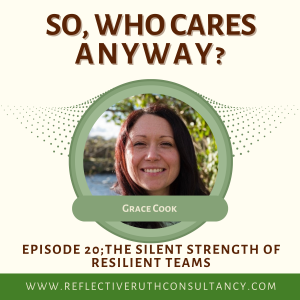
Are you ready to consider what resilience means and how to develop resilient teams?
In this episode, I am delighted to be joined by Grace Cook, a Person-Centred Practice Facilitator at the Foundation of Nursing Studies (FoNS), to explore how Resilience-Based Clinical Supervision (RBCS) shapes workforce wellbeing, recruitment, and person-centred care.
Grace shares how she worked with Professor Gemma Stacey during her PhD research, which led to the development of RBCS, offering structured reflection for nursing professionals.
This episode links closely to previous discussions with Rebecca Myers, exploring the cost of emotional labour, and Adam Lent, discussing the #DoWith approach.
Together, we explore:
The reality of resilience, why the ‘keep calm and carry on’ rhetoric isn’t the full picture.
How structured reflection strengthens teams, helping staff feel valued, supported, and empowered.
Understanding emotional regulation systems, how threat, drive, and soothing responses impact workplace culture.
The power of positive reframing, shifting perspectives to improve care and team dynamics.
Compassionate flow, how the way staff are treated influences the care they provide.
Why person-centred care reduces service demand—meeting real needs rather than cycling through appointments.
This episode is about more than resilience—it’s about creating cultures where professionals thrive, teams grow stronger, and care becomes truly person-centred with a #DoWith approach.